Key Takeaways
- Jharkhand’s student protest escalated on Monday as job aspirants marched towards the state Assembly in Ranchi.
- Police used water cannons, tear gas and lathicharge after protesters crossed multiple barricades near the Assembly.
- Students are protesting alleged irregularities in recruitment examinations conducted by the JPSC and JSSC.
Ranchi: The 17-day-old agitation by Jharkhand’s job aspirants escalated sharply on Monday as thousands of students marched towards the state Assembly in Ranchi, demanding action over alleged irregularities in recruitment examinations conducted by the Jharkhand Public Service Commission (JPSC) and Jharkhand Staff Selection Commission (JSSC).
The protest, which began peacefully, turned tense near the Assembly after demonstrators breached multiple layers of barricading. Police used water cannons, tear gas and lathi-charge to prevent the protesters from moving further towards the Vidhan Sabha.
The confrontation came on a day when the state government said it had already accepted most of the protesters’ demands and announced further measures, including probes into alleged irregularities. The protesters, however, rejected the government’s claim that 98 per cent of their demands had been accepted, saying their key demands, including cancellation of several examinations and an independent probe, remained unresolved.
Students breach barricades, clash with police near Assembly
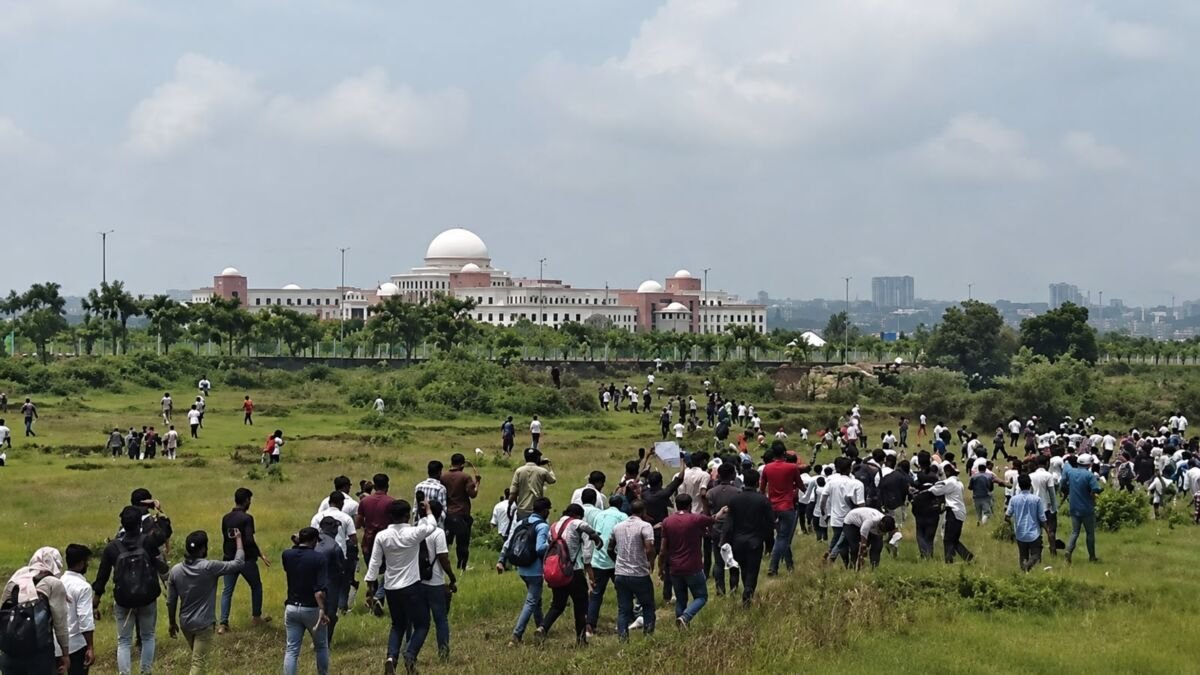
The march began at around 10.30 am from the old Assembly complex in Dhurwa. Carrying the Tricolour, placards and raising slogans, students moved towards the new Vidhan Sabha building as part of the ‘Vidhan Sabha Gherao’ programme organised by the JPSC-JSSC Reform Morcha.
Authorities had imposed prohibitory orders along the four-kilometre route and deployed more than 1,500 personnel, including the Rapid Action Force, Indian Reserve Battalion, district police and Quick Reaction Teams.
As the protesters moved closer to the Assembly, they crossed several layers of barricading. Police first used water cannons near Jagannathpur Temple. Tensions escalated when a section of the protesters attempted to cross the final barricade, following which police resorted to lathi-charge and later used tear gas to disperse the crowd.
The protesters eventually reached the vicinity of the Assembly and, according to officials, some managed to reach Gate No. 1, where they staged a sit-in and refused to leave.
The district administration appealed to them to return, pointing out that the Assembly had already been adjourned for the day. The protesters, however, maintained that they would not leave until their demands were addressed.
Police say protesters pelted stones; students allege excessive force
The police and protesters presented sharply different accounts of the confrontation.
Ranchi City SP Paras Rana said around 90 per cent of the students remained peaceful, but claimed that a section of about 700 to 1,000 protesters broke through the barricades despite repeated appeals from their representatives.
According to Rana, some protesters also pelted stones at the police. He said three police personnel were injured when the crowd pushed through the barricades, while two personnel suffered head injuries requiring stitches. Police maintained that force was used for a limited period to regain control of the situation.
SP Rural Ranchi Gaurav Goswami described the action as a “mild” lathi-charge, saying minimum force was used after protesters attempted to cross the final barricade where prohibitory orders were already in place.
Students, however, accused the police of using excessive force against a largely peaceful demonstration. Several protesters claimed they were injured during the baton charge, while some alleged that women students were also hit.
Devendra Mahto joins march after nine-day hunger strike
One of the most dramatic moments of Monday’s protest came when student leader and Jharkhand Loktantrik Krantikari Morcha (JLKM) leader Devendra Nath Mahto joined the march despite being on a nine-day hunger strike.
Mahto, who had reportedly lost around 10.5 kg during the fast, arrived in an ambulance and subsequently participated in the march on a stretcher. He was carrying a portrait of former Jharkhand chief minister Shibu Soren.
Before joining the march, Mahto had said that the government would have to listen to the students and questioned the heavy security arrangements and spiked barricades put up along the route.
Mahto’s health deteriorated after he joined the protest. He was later admitted to Ranchi Sadar Hospital after a sharp drop in his blood sugar level.
Medical officer Nancy Priya said Mahto’s condition was critical and that he was being treated in the emergency ward. His aide Pankaj Kumar alleged that Mahto had also sustained injuries during the police action near the Assembly.
Even after being hospitalised, Mahto maintained that the agitation would continue and described it as a mass movement of young people demanding accountability in the recruitment system.
What are the students demanding?
The agitation centres on alleged irregularities in recruitment examinations conducted by the JPSC and JSSC.
The protesters are demanding cancellation of several examinations they allege were affected by irregularities, comprehensive reforms in the recruitment process and an independent investigation, including a CBI probe.
The cancellation of the JSSC Combined Graduate Level (CGL) examination has emerged as one of the major sticking points.
The students have rejected the state government’s assertion that 98 per cent of their demands have been accepted. According to the protesters, only three of the 13 examinations for which they sought cancellation have been agreed to be scrapped.
Student leader Ravindra Paswan also accused the government of preferring a CID probe over a CBI investigation and alleged that students had lost confidence in the existing mechanism.
Government announces probes, reforms as protests continue
The confrontation came a day after the Jharkhand government announced a multi-pronged action plan following discussions with representatives of student organisations.
The measures include a CID probe into alleged irregularities in the 14th JPSC examination and backlog recruitments conducted between 2023 and 2025. The government has also agreed to an Enforcement Directorate investigation into suspected financial irregularities, a fast-track court and the formation of an expert committee for recruitment reforms.
The Governor also accepted the resignations of three JPSC members — Ajita Bhattacharya, Anima Hansda and Jamal Ahmed — on Sunday following a recommendation from the state government.
The government has also agreed to cancel three examinations, including the preliminary examination of the 14th JPSC Combined Civil Services Examination. The protesters, however, say these measures do not address the wider concerns surrounding the recruitment system.
Former JPSC chief L Khiangte arrested
Another major development on Monday was the arrest of former JPSC chairperson L Khiangte by the Jharkhand CID in connection with alleged irregularities in recruitment examinations.
Khiangte, who had been appointed JPSC chairperson in February last year after retiring as the state’s chief secretary, had resigned from the post on July 22.
The CID confirmed his arrest as part of its investigation into the recruitment examination irregularities.
Separately, the Enforcement Directorate has initiated a money-laundering investigation into alleged irregularities in multiple recruitment examinations, particularly the JSSC-CGL examination. The agency has taken cognisance of a state CID FIR, complaints and chargesheets to begin its probe under the Prevention of Money Laundering Act.
What happens next?
By Monday evening, the immediate confrontation near the Assembly had largely subsided, with most protesters leaving the site, although some remained to press their demands. Police said no protesters had been detained from the protest site at that stage. But the larger dispute remains unresolved.
The government has pointed to cancelled examinations, investigations, resignations of JPSC members and proposed recruitment reforms as evidence that it is acting on the students’ concerns. The protesters, on the other hand, argue that the core issues — particularly cancellation of additional examinations, a CBI probe and wider reforms of the JPSC-JSSC recruitment system — remain pending.
With the agitation now entering its third week, Monday’s confrontation has added a new dimension to the recruitment row. The police action, Mahto’s hospitalisation, the arrest of a former JPSC chairperson and the BJP’s call for a statewide bandh have ensured that the dispute is unlikely to end with the Assembly march.
For thousands of aspirants, the central question remains unchanged: whether the state government will agree to the remaining demands and provide a recruitment process they believe is transparent, credible and free from irregularities.