
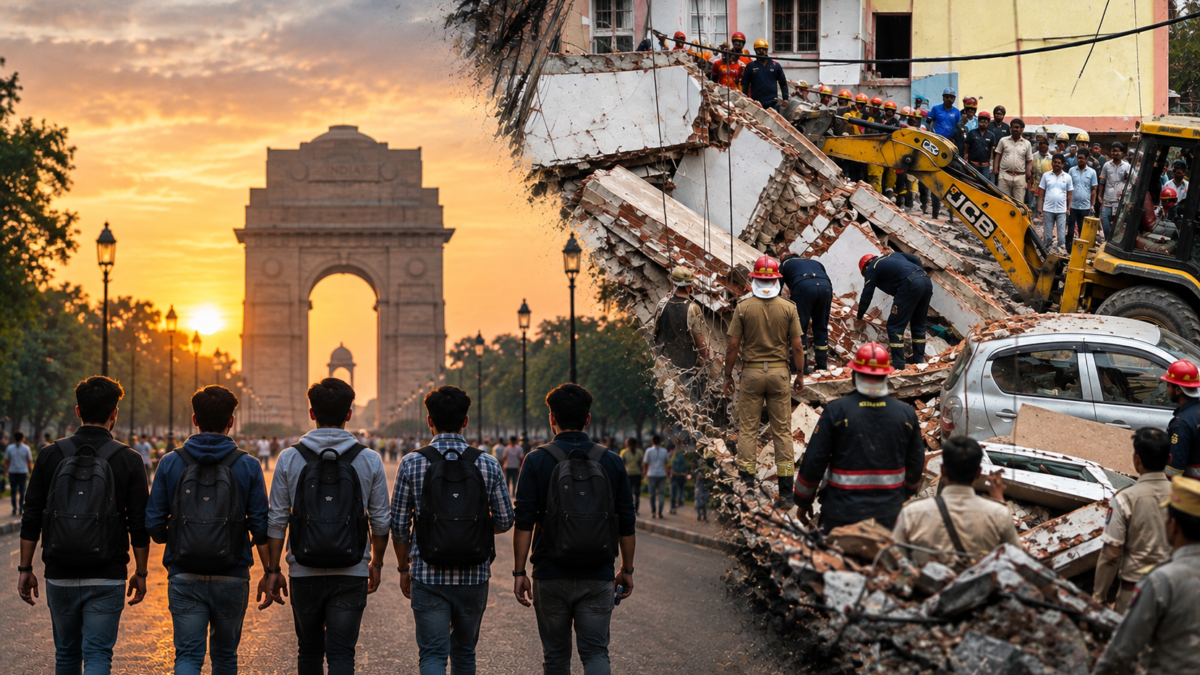
Arpit Jahaj (18), Yuvraj Soni (20), Akshat Singh Yadav (18), Abhishek Kumar (20) and Pawan Kumar (17). These were the five students who lost their lives in the Satya Niketan PG collapse. Seven people died in the tragedy, including two labourers. Five young students, five families and five sets of dreams that had brought them to Delhi.
Perhaps that is the most painful part of this story. Their dreams brought them to Delhi, but Delhi failed to give them a safe place to live.
Look at where these boys came from — Auraiya, Katni, Durg and Dewas. You may have barely heard of some of these cities. They are small cities and towns from where a middle-class student often has to convince his parents, fight their fears and leave home for the first time to build a future. For many families, sending a son or daughter to Delhi is a financial decision, an emotional decision and, in many cases, a leap of faith. Parents know that their child is going to a city that is far more expensive and competitive than the place they have grown up in. But they still send them because they believe that education can change their child’s life.
I understand that feeling because I have lived it myself. I spent the first 18 years of my life in Sitapur, my hometown. In 2016, I came to Delhi to study journalism. Convincing my family was not easy. They were worried and did not want me to leave. For them, sending their son to another city was a big decision. But for me, coming to Delhi was equally important. I believed I needed to be here to pursue what I wanted to do.
Coming to Delhi is difficult, but living in Delhi can be even more difficult. When I came to Delhi, I didn’t stay in a PG. Instead, I rented a small room in Taimoor Nagar. I still remember the room I lived in. It was so small that you could barely imagine fitting a bed inside it. The rent was Rs 3,500 a month in 2016.
Over the years, I have lived in different parts of Delhi and dealt with all kinds of landlords. As a student, you have little bargaining power when you know you have limited options. The problem isn’t every landlord; it’s a system where a student’s vulnerability can become a business opportunity.
Satya Niketan is perhaps the clearest example of this. A student has become a paying bed. Satya Niketan has more than 200 PG accommodations. Its proximity to Delhi University’s South Campus and several colleges has turned the area into a major student accommodation hub.
Now look at what students are paying for these rooms. Students have reported paying around Rs 10,000–Rs 12,000 per bed for triple- or four-sharing rooms. A better double-sharing room can cost Rs 15,000 or more per bed, while a single room can cost around Rs 25,000 a month. An India Today ground investigation found rooms measuring approximately 8×10 feet — around 80 square feet — being offered for Rs 9,000–Rs 12,000 without AC and Rs 18,000–Rs 20,000 with AC. The report also highlighted issues such as damp walls, leaking pipelines and inadequate lighting in some properties.
Think about what that means. A student may be paying Rs 10,000, Rs 15,000 or even Rs 20,000 a month and still be living in a tiny room shared with two or three other people. Food, electricity and laundry can be additional expenses. For a student from a middle-class family in a small town, that is not a small amount of money. Yet they pay it because they have to. The student needs the room more than the landlord needs the student. That is where the power imbalance begins.
Another partition can mean another student. Another floor can mean more rooms. Another room can mean three or four more tenants. And every additional tenant means more rent.
According to MCD officials, the building that collapsed in Satya Niketan had permission for only a G+1 structure, while the structure that existed was much larger. The exact causes of the collapse and responsibility for it will be determined through the ongoing investigation. But one fact cannot be ignored: students were living there, students were paying to live there, and seven people died.
The Times of India also reported that the PG agreement contained a clause saying the PG authorities would not be responsible for casualties to tenants. That raises a very basic question: When a student pays rent to live somewhere, who is responsible for ensuring that the place is safe?
The hostel shortage is no secret. Satya Niketan is not an isolated problem but a result of the huge gap between students needing accommodation and the limited hostel beds available. When universities can’t provide enough housing, students are forced into private PGs and rentals.
According to official figures, Delhi University has 2,51,474 students enrolled in conventional programmes — including 2,10,907 undergraduates, 34,520 postgraduates and 6,047 students enrolled in certificate, diploma and postgraduate diploma programmes. A large proportion of these students come from outside Delhi. Yet DU has only around 7,224 official hostel beds, including 3,688 in college hostels and 3,536 in DU’s non-college hostels, according to recent reporting. Another 863 beds are expected to be added through hostels under construction at Hindu, Hansraj, Ramjas and Kalindi colleges.
Even if we assume that around 1.2 lakh DU students are from outside Delhi, the existing hostel system can accommodate only around 6% of them. That leaves more than 1.13 lakh students potentially looking outside the official hostel system.
And where do they go? They go to Satya Niketan and countless other neighbourhoods where the private student-rental market has grown around universities. So when someone asks, “Why did these students live in a PG?” the answer is simple: where else were they supposed to go?
We knew that DU had a hostel shortage. We knew that thousands of students come to Delhi from outside the city. We knew that private PGs had become an essential part of the student accommodation ecosystem. We knew that residential properties were being converted into high-density student accommodation. So why wasn’t there a comprehensive system to monitor them? Why weren’t building permissions, structural safety, fire safety and occupancy limits being routinely checked?
Following the Satya Niketan tragedy, MCD surveyed PG properties in the area and identified three buildings as dangerous. That raises an uncomfortable question: Were these buildings dangerous only after the tragedy, or were they dangerous before it too? If they were dangerous before, why weren’t they identified earlier?
After the Satya Niketan collapse, an 18-member high-powered committee was constituted to examine Delhi’s student accommodation crisis. Its mandate includes assessing demand and supply, identifying land for student accommodation, exploring the conversion of unused government properties into hostels, creating a database of PGs and hostels, establishing safety standards and developing a grievance-redressal mechanism for students.
These are all necessary steps. But I cannot help asking: Why now? Why does the system wake up only after a tragedy? Do we need a building to collapse every time before someone checks whether it was legally constructed? Do we need students to die before we ask whether the PG they were living in was safe?
A committee can submit recommendations in 60 days. Governments can announce new hostels. Departments can conduct inspections. Portals can be created. But none of that brings Arpit, Yuvraj, Akshat, Abhishek or Pawan back.
Maybe we cannot change the thinking of every landlord who sees a student as a source of income. But we can change the system that allows an unregulated accommodation market to flourish around educational institutions. The government needs to create a proper regulatory framework for private PGs. Every PG should be registered, its building permissions should be verified, structural and fire-safety inspections should be mandatory, occupancy should be regulated and students should know exactly what they are paying for.
There should be a public database where students can check whether a PG is registered and whether it has passed the required safety checks. At the same time, DU and the government should explore unused public buildings, new student housing projects and partnerships with responsible private operators. If private PGs are going to remain an unavoidable part of Delhi’s student accommodation system, then they must be treated as an extension of the student ecosystem, not simply as businesses operating around it.
Because when DU admits a student from Auraiya, Katni, Durg or Dewas, its responsibility cannot end at the college gate. That student came to Delhi because he believed education could change his life. His parents sent him because they believed Delhi would give him an opportunity. They should not have had to choose between pursuing their dreams and staying safe.
Arpit. Yuvraj. Akshat. Abhishek. Pawan.
They were not five beds. They were not five sources of rent. They were not five names on a police list. They were young people who came to Delhi to build a life.
And perhaps the biggest failure here is not that Delhi could not fulfil their dreams.
It is that Delhi could not even give them a safe room in which to dream.