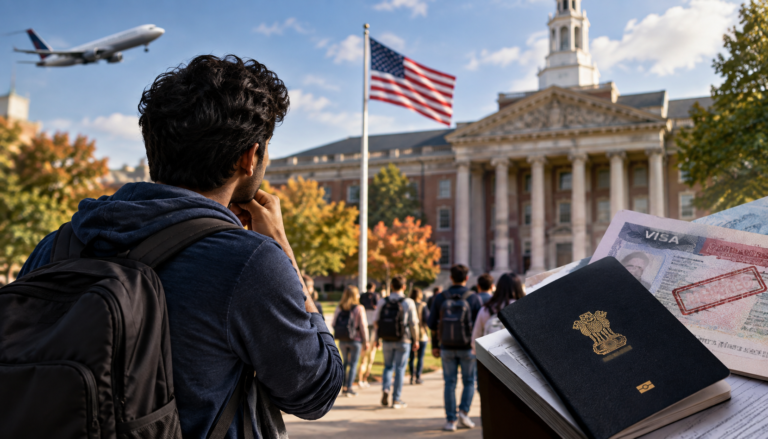

International education is entering a new phase in 2026, with students increasingly evaluating overseas education through the lens of affordability, flexibility, employability and long-term career outcomes. While traditional destinations such as the United States and the UK continue to attract international students, changing expectations are also encouraging learners to explore emerging destinations and alternative modes of education, including online and blended programmes.
Education leaders say the shift is prompting institutions to rethink how international programmes are designed and delivered, with greater emphasis on digital learning, industry exposure, global recognition and flexible pathways.
From International Degrees To Career Outcomes
One of the clearest changes in student behaviour is the growing emphasis on what an international qualification can deliver beyond the classroom.
Dr. Ramesh Sinanan, President, Birchwood University, said students are increasingly prioritising flexibility, career outcomes, affordability and global exposure when deciding where and how to study.
According to Sinanan, the United States continues to remain a preferred destination because of its universities, research ecosystem, industry linkages and diverse academic opportunities. However, the changing student profile is also encouraging US institutions to rethink traditional approaches to education, with greater emphasis on digital learning, flexible programmes, experiential education and employability.
The shift reflects a broader change in how students perceive international education. Rather than viewing an overseas qualification simply as a prestigious academic credential, learners are increasingly looking at the skills, experiences and career opportunities attached to it.
Vivek K. Singh, CMD, SNVA Veranda, similarly said international education is entering a transformative phase, driven by students seeking greater flexibility, affordability, global exposure and career relevance.
He said institutions will need to build globally relevant programmes, strengthen digital learning ecosystems and create pathways that combine academic excellence with employability.
Online And Blended Learning Reshape The Study-Abroad Model
Another significant development is the growing role of online and blended learning.
Traditionally, international education has been closely associated with physical relocation. Students would move to another country, enrol in a university and spend several years studying on campus. The expansion of digital education is gradually changing that model.
Dr. Gary Latta, President, London School of Management and Technology, said students are increasingly seeking learning options that can fit around their careers, families and personal commitments.
Online education allows learners to pursue qualifications from institutions in other countries while remaining in their home environments. For working professionals and students who may not be able to afford relocation or extended career breaks, this creates an alternative route to international education.
The development is also prompting universities and higher education providers to introduce online programmes, digital classrooms and flexible learning pathways.
What was once considered an alternative mode of education is increasingly becoming an integral part of the international education ecosystem.
The Global Education Map Is Widening
The rise of alternative delivery models is happening alongside changing destination preferences.
The growing interest in emerging destinations does not necessarily mean that established education hubs are losing their relevance. The US, UK and other major destinations continue to have strong appeal because of their universities, research opportunities, industry connections and international recognition.
At the same time, students are becoming more open to considering destinations beyond the traditional choices.
Prof. (Dr.) Shailendra Naresh Kulkarni, Group Rector, Euro American Education Group, said international education is becoming a more interconnected, flexible and quality-conscious ecosystem.
According to him, students are increasingly looking beyond traditional destinations and placing greater emphasis on academic credibility, international recognition, flexibility, employability and the quality frameworks supporting their qualifications.
He said this has strengthened interest in education pathways spanning Switzerland, the United States, the UK and wider Europe.
The trend indicates that destination choice is increasingly being influenced by the overall value proposition offered by an institution and programme, rather than geography alone.
Recognition And Quality Gain Importance
As international education becomes more diverse, the question of credibility is also becoming increasingly important.
Students pursuing qualifications across borders need greater clarity about recognition, academic standards and the quality assurance mechanisms associated with their programmes.
Kulkarni highlighted the role of different organisations and frameworks supporting areas such as higher education, business education, distance learning, quality assurance and professional qualifications.
The broader trend is towards students becoming more conscious of the credibility and recognition of the qualifications they pursue.
Prof. (Dr.) Mensur Zeqiri, Rector, EIMT, said international education in 2026 is moving towards greater flexibility, accessibility and credibility.
He said students and working professionals are increasingly seeking globally recognised qualifications that offer academic rigour without requiring them to relocate or step away from their careers.
According to Zeqiri, this is strengthening the appeal of online and blended learning, particularly where programmes are supported by established quality and accreditation frameworks.
Institutions Face A Changing Set Of Expectations
The changes in student preferences are also forcing institutions to reconsider how they compete in the international education market.
Academic reputation remains important, but institutions increasingly need to demonstrate how their programmes connect education with employability, industry exposure and real-world skills.
Technology is becoming an important part of this transition. Digital classrooms, personalised learning, flexible programmes and online delivery are allowing institutions to reach students who may previously have been excluded by geographical or financial constraints.
Industry partnerships are also becoming increasingly relevant as students look for programmes that can translate academic learning into professional opportunities.
For institutions, therefore, the challenge is no longer simply to attract international students. They must also demonstrate why their programmes are worth the financial and time investment.
From Study Abroad To Global Education
Taken together, these developments suggest that international education is moving away from a one-dimensional focus on geography.
For students, the question is increasingly not simply where to study, but what value a programme offers — from recognised credentials and academic quality to flexibility, affordability, industry exposure and career outcomes.
For institutions, this is creating pressure to redesign programmes around changing learner expectations. Digital delivery, industry partnerships, personalised learning and flexible pathways are likely to become increasingly important as institutions compete for a more informed and cost-conscious international student base.
In 2026, international education is therefore becoming less about simply crossing borders and more about accessing globally relevant learning opportunities — whether or not the learner physically crosses one.